after Groundswell
this was a letter as reflection—or reflection as letter—after reading Yanara Friedland's Groundswell.
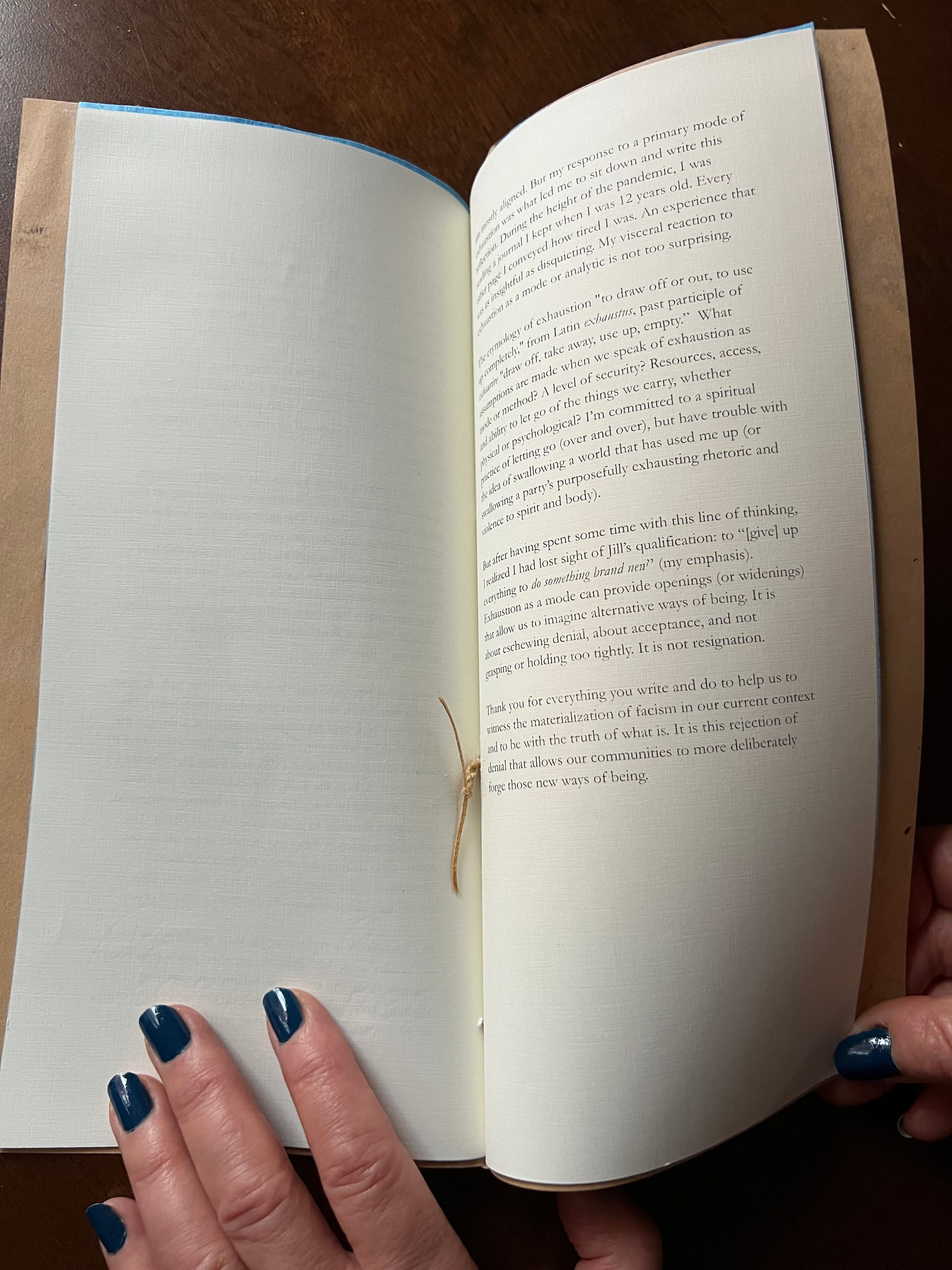
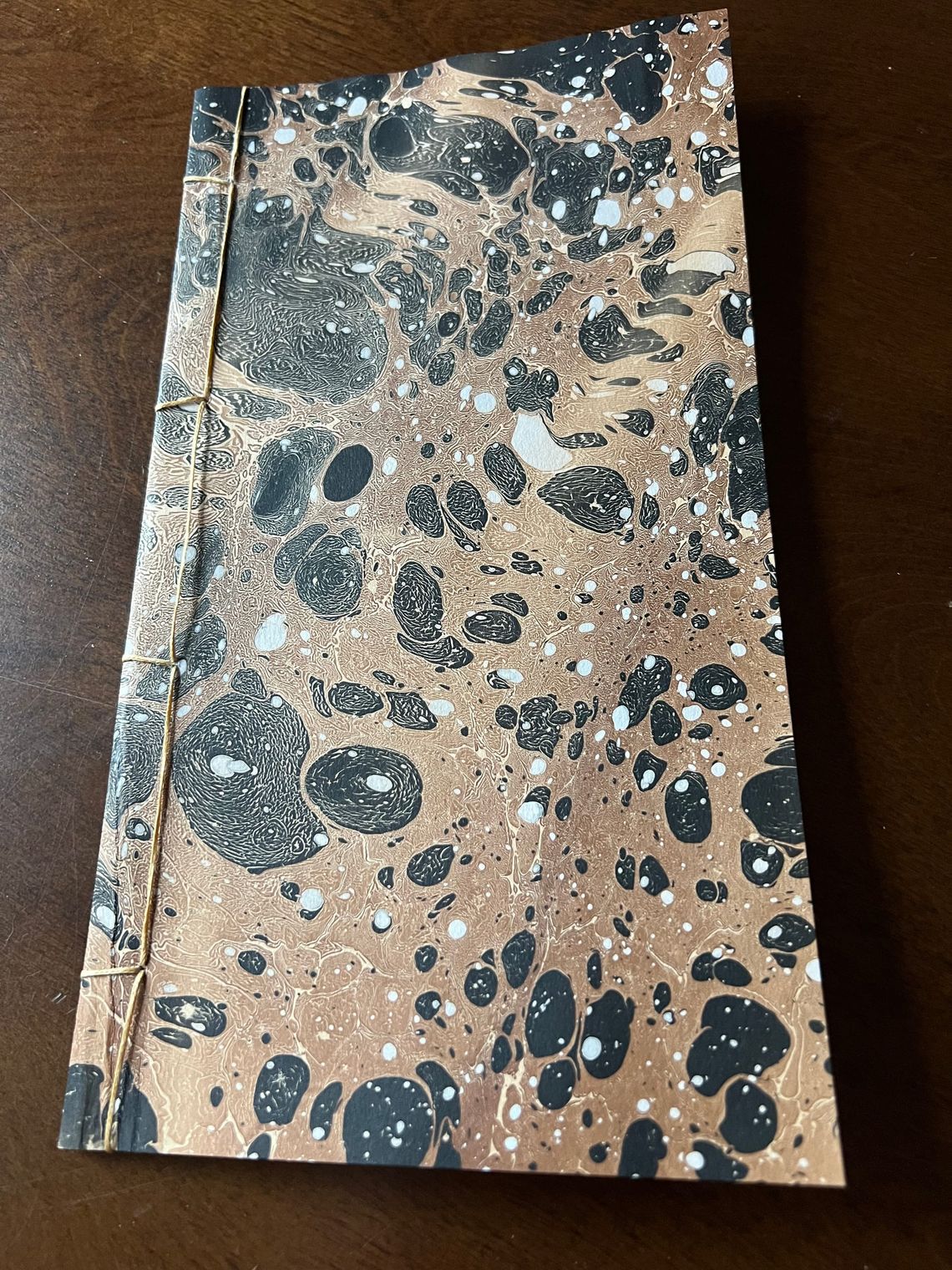
after finishing the piece, I bound a wee book (about 7x4) and then posted to Yanara. the marbled paper is courtesy of Sarah Maker (Editions Press).
written and edited over September and October—i.e. before the election. it already feels outdated. call it post-11/05/24.
<><>
dear Yanara,
When I met you at &Now, I think your baby had just been born—Robert and I had met previously in Tucson; maybe you were traveling at the time. Maybe you were in Frankfurt Oder for your fellowship. It seems we barely know one another, but I feel this clear kinship in preoccupations: borders, belonging, dis/connection.
After reading Groundswell, I’m thinking about the United States dance (though dance seems inadequate; maybe full bore gyrations) with fascism. I did not remember learning about the Entartete Kunst—all modern art of the time as degenerate.
But I was thinking about the ways as a country we might be even closer than 1937 Germany in suppressing art that speaks to these gyrations. The utter commodification of art so commonplace or near complete. Art that has the broadest reach, with exceptions of course, depoliticized and absent of meaningful social critique. Yours seems to refuse that commodification. In the “other” Frankfurt Oder university’s basement, oral histories are re-politicized, reflected. “Odra in Polish means ‘river.’ Oder in German means ‘or.’” River or.
I read about you watching the collapse of the wall on your father’s shoulders, eating the gingerbread man, taking his cookie-clay pipe and pretending to smoke it. I went to the Berlin Wall, or what remained of it, less than a year after it came down. It was May of 1990, and I was 21. What do I remember? Art on the walls, both celebratory and grave. Bodies dancing on ruin. Testament to human segregation. Getting on the train to go to dinner in East Berlin. The radical difference in dress and manner of people on the train—clear delineation of east Berliner and west. “Severance is the great locutor.” Let us raise our flags in thorny twig demarcation—“I dream of a type of crying.”
In Groundswell’s introduction, Jill Magi speaks of the book as “border work 2.0.” Brilliant. She then posits your book’s primary mode and analytic as exhaustion, clarifying “no solution, no epiphany, no landing on one side or the other, no progress.” With those areas of resistance or refusal, I am mostly aligned. But my response to a primary mode of exhaustion was what led me to sit down and write this reflection. During the height of the pandemic, I was reading a journal I kept when I was 12 years old. Every other page I conveyed how tired I was. An experience that was as insightful as disquieting. My visceral reaction to exhaustion as a mode or analytic is not too surprising.
The etymology of exhaustion "to draw off or out, to use up completely," from Latin exhaustus, past participle of exhaurire "draw off, take away, use up, empty.” What assumptions are made when we speak of exhaustion as mode or method? A level of security? Resources, access, and ability to let go of the things we carry, whether physical or psychological? I’m committed to a spiritual practice of letting go (over and over), but have trouble with the idea of swallowing a world that has used me up (or swallowing a party’s purposefully exhausting rhetoric and violence to spirit and body).
But after having spent some time with this line of thinking, I realized I had lost sight of Jill’s qualification: to “[give] up everything to do something brand new” (my emphasis). Exhaustion as a mode can provide openings (or widenings) that allow us to imagine alternative ways of being. It is about eschewing denial, about acceptance, and not grasping or holding too tightly. It is not resignation.
Thank you for everything you write and do to help us to witness the materialization of facism in our current context and to be with the truth of what is. It is this rejection of denial that allows our communities to more deliberately forge those new ways of being.